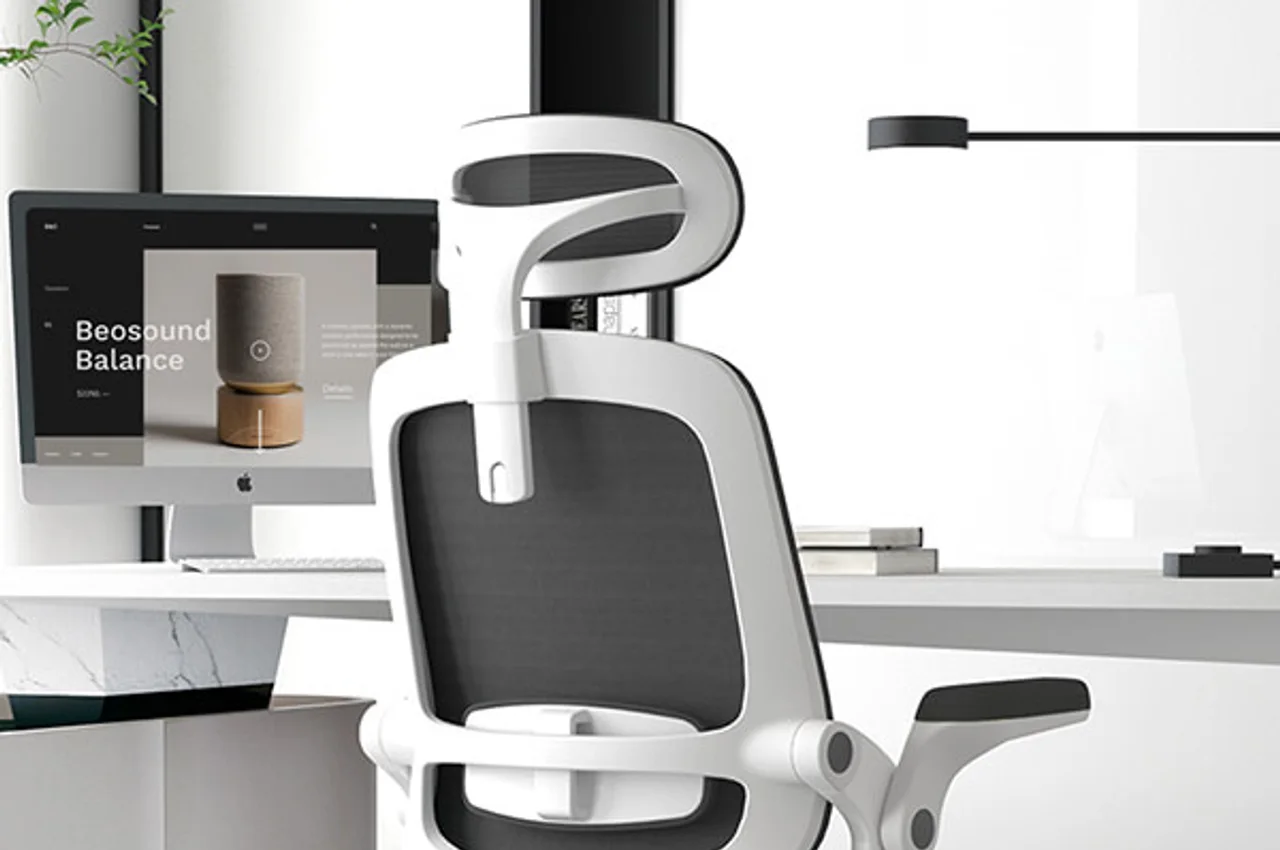
When a chair sits in one person's home office, fit is a one-time setup. When it sits in a shared, open-plan or hot-desk office, a different body sits down every day, and the chair has to move to fit each of them. That is what separates a real task chair from a desk chair with a lever, and it is where a contract spec earns its money. Here is what the spec should actually list, and what each setting is for.
The settings that matter
- Seat height: the basic one, but the range is what counts. EN 1335 sets a 400 mm minimum with at least 120 mm of travel — enough to take a short and a tall user to a desk without a footrest battle.
- Seat depth: a sliding seat so the user can set the gap behind the knees. This is the adjustment most often dropped to save cost, and the one tall and short users notice fastest.
- Backrest height or lumbar: the lumbar support has to land in the curve of the back, and bodies put that curve at different heights — so either an adjustable backrest or a height-adjustable lumbar.
- Recline and tension: a synchro recline with weight-matched tension, so a 55 kg and a 100 kg user both get supported movement rather than a chair that fights one of them.
- Armrests: at minimum height-adjustable; for shared desks, width or depth too, so arms are supported without colliding with the desk edge.
What each one is really doing
None of these are comfort luxuries. Seat height and depth set the user's thighs and feet so circulation is not cut off across a working day. The lumbar height keeps the spine supported instead of slumped. The recline tension is what we cover in our synchro mechanism guide — wrong tension is the single biggest source of "this chair is uncomfortable" complaints, and it is a setting, not a defect. Armrests carry the shoulders; fixed arms at the wrong height load the neck instead.
The trade-off
Every adjustment adds cost and a part that can fail, so more is not automatically better. For an executive office with one named user, you can fit a chair once and skip the seat slider and the 4D arms — that user will set it and never touch it again. For a shared floor, cutting the seat-depth slider or the lumbar adjustment to hit a price means the chair fits the average person and is wrong for everyone else, and that shows up as people swapping chairs and complaining. Match the adjustability to whether the chair has one owner or many. That is the real decision, not "how many features can we fit".
Armrests are where money is wasted or saved
Armrests deserve their own paragraph because they are where buyers most often over- or under-spend. The shorthand is the "D" count. A 1D arm adjusts height only. A 2D adds depth (forward and back). A 3D adds width (in and out). A 4D adds pad rotation. Each D adds cost and a moving part. For a shared contract floor, height-adjustable arms are the floor — fixed arms at the wrong height load the neck and are the cheapest false economy on the chair. But jumping to 4D arms on a general task chair is paying for adjustment most users never touch; we keep 3D and 4D for executive lines and for desks where the arm has to clear a specific keyboard tray. Spec the D count to the desk, not the brochure.
One field note that saves returns: check the armrest pad and the lock. A height-adjustable arm that slowly drops under elbow weight, or a pad that slides off, generates more complaints than fixed arms ever would. We test the arm height-lock as part of the EN 1335 and BIFMA durability cycling, because an arm that fails is an arm that comes back.
How we spec it
Tell us who sits in the chair — one person, a fixed team, or open hot-desking — and we recommend the adjustment set for that case rather than defaulting to the longest feature list. Our mesh task chairs and ergonomic chairs are built to EN 1335 dimensional types so the adjustment ranges line up with the type a tender names, and testing to EN 1335 and BIFMA can be arranged per order.
A last word on how to write the spec itself: list the adjustments you need as ranges and behaviours, not brand names. "Seat height 400–520 mm, seat-depth slider, height-adjustable lumbar, synchro recline with weight-matched tension lock, height-adjustable arms" tells us exactly what to build and tells your buyer exactly what they are getting. A spec that just says "fully adjustable ergonomic chair" invites every supplier to interpret it down to their cheapest configuration. Send the user profile and quantities through the contact form or [email protected], and we will spec the adjustability to the floor, not the brochure. See the full range on our products page.